Kariux Editorial
Author · Aug 05, 2026
Ask most marketing teams how growth is going and you'll get an answer shaped like a graph with peaks in it. A launch spiked traffic. A campaign spiked sign-ups. A promotion spiked revenue for a quarter. Then the line comes back down, and the team starts planning the next spike.
That shape; up, down, up, down, always resetting near the same baseline is the signature of a business running on campaigns instead of systems. It's exhausting to sustain, it makes every quarter feel like starting over, and it's the single most common reason growth teams burn out chasing numbers that never seem to stick.
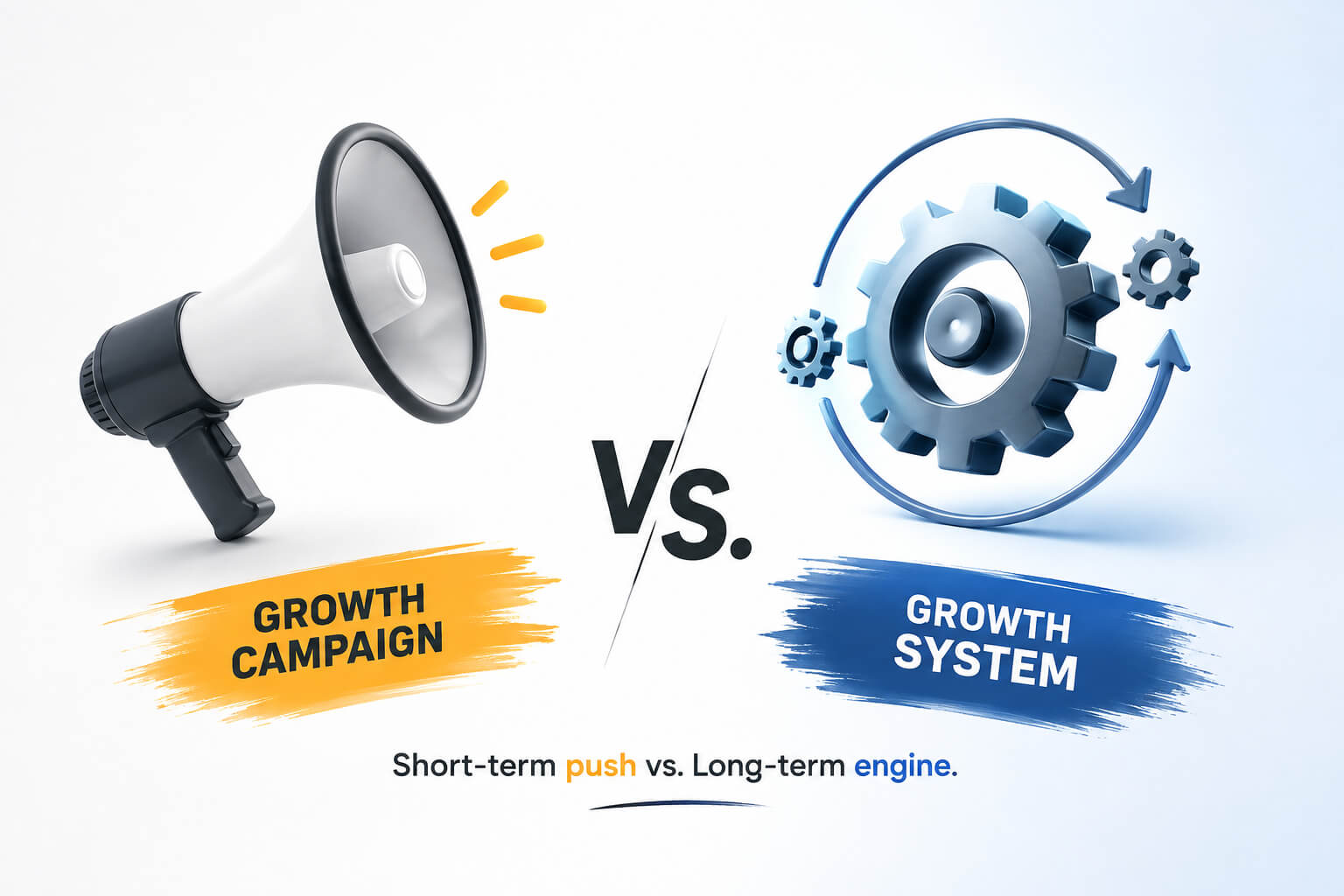
There's a different shape available. It looks less dramatic month to month and radically better over two years: a line that keeps climbing, with each new initiative building on what the last one already established instead of starting from zero. That's what a growth system produces instead of a growth campaign and the difference between the two is one of the most consequential distinctions in how a company actually grows.
What a campaign actually is
A campaign has a start date, an end date, and a goal that lives inside that window. A product launch push. A holiday promotion. A paid social burst timed to a funding announcement. Campaigns are useful; genuinely, not begrudgingly. They create urgency, they generate a spike of attention, and sometimes a spike is exactly what a specific moment calls for.
The problem isn't that campaigns exist. It's what happens the moment a campaign ends: usually, close to nothing carries forward. The audience that clicked doesn't automatically become an audience you can reach again next month. The creative that worked doesn't automatically get smarter next time, it gets thrown out and replaced with a new idea that has to prove itself from scratch. The team learns something, but the business doesn't retain a compounding asset from having run it.
Run enough campaigns back to back and you get a company that's perpetually busy and only inconsistently growing because every initiative is disconnected from the one before it, and every quarter starts the trust-building, audience-building, and optimization process over again.
What a system does differently
A growth system is built around a different question than a campaign. A campaign asks: how do we get a result by this date? A system asks: how do we build something that makes every future result cheaper and faster to get?
In practice, that means a few structural things a campaign rarely has:
It owns an asset that survives the campaign. An email list that grows with every touchpoint instead of resetting. A content library that keeps ranking and compounding organic traffic long after the writer moved on. A referral loop that keeps producing new customers without a media spend behind it. A retargeting audience built from a year of accumulated signal instead of last week's ad set. The specific asset varies by business; the pattern doesn't: something is being built that didn't exist before, and it keeps paying out after the initiative that created it is over.
It gets cheaper and better with each cycle, not just busier. A well-built system uses the data and creative from the last cycle to inform the next one, the winning ad angle from Q1 doesn't get discarded in Q2, it gets refined. Conversion insight from the last product launch informs the messaging on the next one. Every cycle should make the following cycle require less effort for the same or better result. If costs and effort stay flat cycle over cycle, it's not compounding, it's just repeating.
It doesn't depend on any single channel staying favorable. Campaigns often lean hard on whatever channel is cheapest or hottest right now, which is exactly the channel most likely to get more expensive or more saturated soon. Systems are typically built across owned, earned, and paid together, so a shift in one platform's algorithm or cost structure doesn't take the whole growth engine down with it.
How to tell which one you're actually running
Most teams believe they're building a system when they're actually running a string of campaigns with a shared logo. A few honest questions tend to reveal which is true:
- If you stopped all paid spend for 60 days, would growth continue at any meaningful pace? If the honest answer is no, there's no system underneath the spend; there's a faucet, and it's currently the entire strategy.
- Does last quarter's work make this quarter's work easier, cheaper, or faster; specifically, not just generally? "We learned a lot" is not the same as "we built something we're now using." If nothing concrete carried forward, it was a campaign.
- Is there an asset; a list, a library, a loop, an audience that's measurably bigger or stronger than it was two quarters ago? If growth is a rolling total of separate wins rather than a growing asset, that's the campaign signature.
- Would a new team member need a full re-briefing to understand "how we grow," or is the system documented and legible enough that it explains itself? Systems are describable. Campaigns are usually a collection of tribal knowledge about what worked that one time.
Why this distinction matters more as a company scales
Early on, campaigns are often the right call; there isn't yet enough traction, budget, or certainty about what works to justify building durable infrastructure around it. Testing fast and disposably makes sense when you're still finding product-market fit.
The trouble starts when a company keeps operating this way well past the point where it should have started compounding. Every additional quarter spent running disconnected campaigns is a quarter where a competitor further along the system curve is getting cheaper, faster, more predictable growth from the same size budget — because their last two years of work are still paying interest, and yours reset every ninety days.
The fix isn't to stop running campaigns entirely. Campaigns still have a place; a real launch moment, a genuine news hook, a seasonal spike worth capturing. The fix is making sure campaigns are built to feed a system instead of existing as isolated events: every campaign should leave something behind, a bigger list, a proven creative angle, a stronger retargeting pool, a piece of content that keeps ranking, so the next campaign starts from a taller floor than the last one did.
That's the actual difference between a growth team that feels perpetually behind, restarting the sprint every quarter, and one where growth genuinely gets easier over time. It's rarely about working harder on the next campaign. It's about whether the last five campaigns left anything behind to build on.