

Administrator
Author · Jun 05, 2026
Most content strategies have a half-life. You publish a post, it ranks for a while, traffic slowly decays, and you publish more to make up for it. The treadmill never stops. The moment you stop running - when budgets tighten, headcount drops, or priorities shift - the traffic drops with it.
Topic clusters break that pattern. Built correctly, they don't decay. They compound. Each piece of content you add to a cluster makes every other piece in it stronger. The internal links pass authority around the structure. The topical signal to search engines and AI systems grows more confident. Rankings become stickier. And AI citation rates - increasingly the metric that determines visibility in 2026's fractured search landscape - climb disproportionately for sites that structure their content this way.
This is why topic clusters have moved from "smart SEO practice" to foundational content architecture. It's not a trend. It's a structural response to how search works now.
Why Random Blog Posts Stopped Working
To understand why topic clusters matter, you need to understand what replaced them.
For years, the dominant content strategy was simple: identify a keyword with search volume, write a post targeting that keyword, build links, and rank. Do it again for another keyword. Do it again. This worked well enough when search engines evaluated pages in relative isolation - matching a query to the closest keyword-optimized document.
Google's algorithms have moved well beyond that model. Its systems now evaluate topical authority - whether a site demonstrates comprehensive, coherent expertise across a subject rather than isolated coverage of individual queries. A site with twenty interconnected articles on email marketing will consistently outrank a site with one technically superior 5,000-word guide on the same topic. The question has shifted from "is this page a good match for this keyword?" to "is this site a genuine authority on this subject?"
The practical consequence for teams still running the old playbook:
Content cannibalization. When multiple posts target the same or overlapping keywords, search engines can't determine which page to rank. They often rank none of them well, or alternate unpredictably between them, fragmenting authority that could be concentrated in a single strong page.
Authority dilution. Standalone posts don't share authority. Each one competes independently for rankings and backlinks. The compounding benefit of an interconnected network never materializes.
Invisible content. Semrush research shows that 25% of web pages have zero incoming internal links - essentially, orphan content invisible to both crawlers and users. Pages buried at depth 4 or greater in site architecture receive 9x less SEO traffic than those at depth 1-3. Most content teams have far more of this orphaned content than they realize.
Short ranking windows. Standalone posts hold rankings for a fraction as long as clustered content. HireGrowth's 2025 analysis found clustered content holds rankings 2.5x longer than standalone pieces. The investment pays off for longer.
The pivot to topic clusters is a response to all of these problems simultaneously.
What a Topic Cluster Actually Is
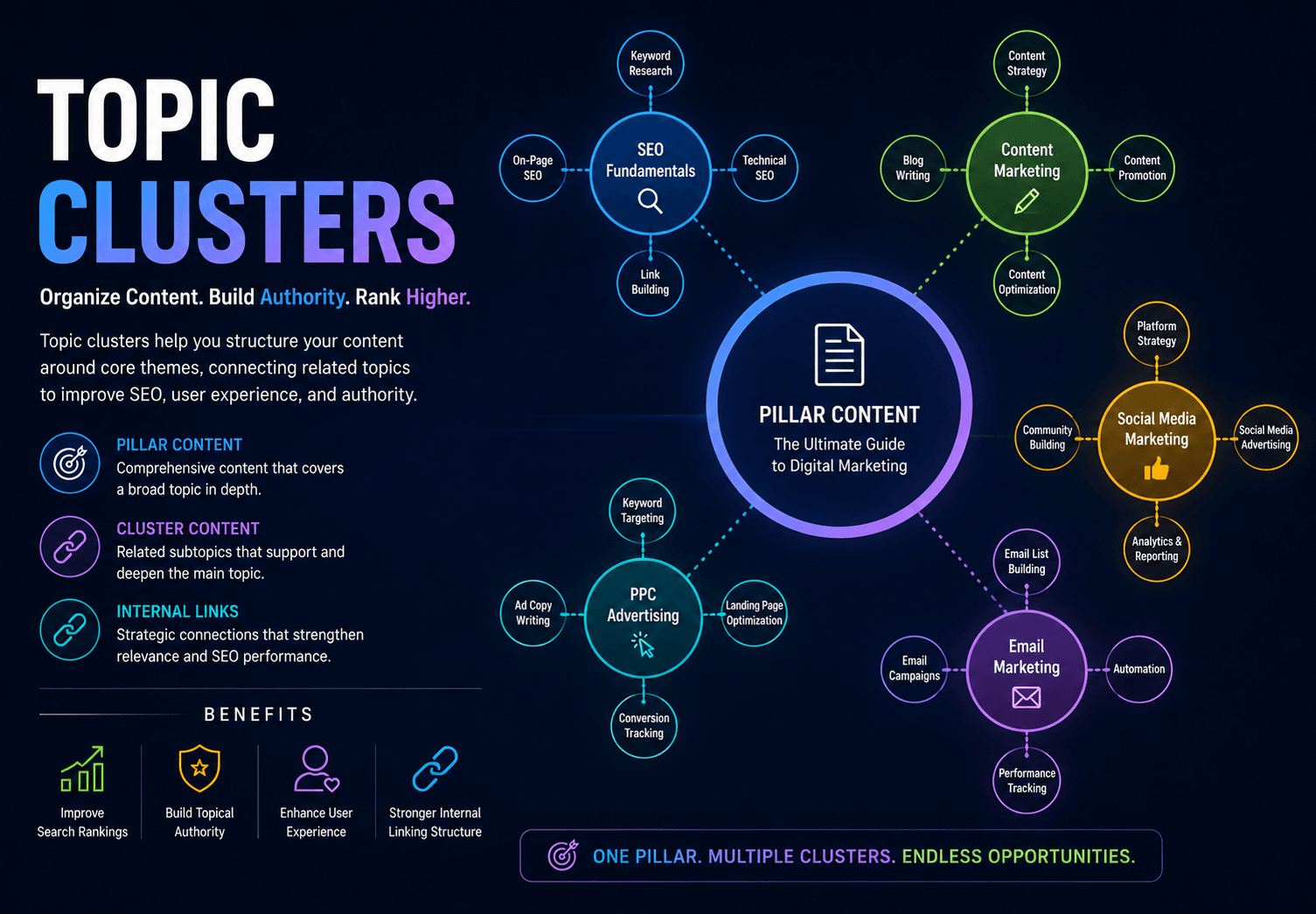
A topic cluster is a content architecture built around three elements working together: a pillar page, a set of cluster pages, and the internal links connecting them.
The pillar page is the comprehensive anchor of the cluster. It covers a broad subject in full - typically 3,000-6,000 words - addressing the topic's primary questions, major subtopics, and common confusions at a high level. It's the page you'd point to if someone asked you to show them everything your site knows about a subject. HubSpot's Leslie Ye offers a useful sniff test: "Would this page answer every question the reader who searched X keyword had, AND is it broad enough to be an umbrella for 20-30 posts? If you're trying to get it to rank for a long-tail keyword, it's not a pillar page."
The cluster pages are individual articles - typically 800-1,500 words each - that go deep on specific subtopics the pillar page introduces but doesn't fully explore. If the pillar is "Email Marketing," cluster pages might cover deliverability best practices, segmentation strategies, subject line A/B testing, automated welcome sequences, and re-engagement campaigns. Each cluster page targets a specific long-tail query and brings a distinct user intent within the topic's domain.
The internal links are what make the whole thing a system rather than a collection. Every cluster page links back to the pillar, and the pillar links out to every cluster page. Related cluster pages cross-link to each other where genuinely relevant. This bidirectional linking structure creates what SEO practitioners call a closed authority loop - a network where every link strengthens the whole.
The architecture signals to search engines: "This site has comprehensive, organized knowledge about this topic." It signals to AI retrieval systems: "There is a coherent, interconnected body of content here - this is a credible source to cite."
The Compounding Mechanism, Explained
Understanding why topic clusters compound matters more than just knowing that they do.
When a cluster page earns a backlink from an external site - common for useful, specific content - that authority doesn't just stay on that one page. Through internal links, it flows to the pillar page and from there to all other cluster pages in the network. A single external link effectively lifts the entire cluster.
As more cluster pages are added, each one expands the topical footprint that the structure covers. More subtopics covered means more long-tail queries captured. Capturing more long-tail queries means more users entering the ecosystem from different points in the funnel. More user journeys through the interconnected content means stronger behavioral signals to search engines - longer sessions, lower bounce rates, more pageviews per visit - all of which reinforce topical authority.
Moz's 2025 research documented that websites implementing topic clusters see an average 34% increase in internal PageRank for cluster pages within 60 days of implementation - without acquiring a single new external link. The structure itself redistributes existing authority more efficiently.
The time dimension matters too. HireGrowth's 2025 analysis found that clustered content drives 30% more organic traffic than standalone posts. Sites that sustain cluster publishing for 12+ months see 40% higher organic traffic than comparable single-page strategies. The longer the cluster runs, the stronger the compounding effect. This is fundamentally different from the paid media model, where traffic stops the moment the spend stops.
One marketing agency implemented topic clusters for a client and documented organic blog traffic growing from 500 to nearly 190,000 monthly visitors - a 37,900% increase - through systematic cluster implementation. HubSpot's own restructuring of its blog increased target keyword clicks by more than 500% and grew Domain Authority from 49 to 60.
Topic Clusters in the Age of AI Search
The case for topic clusters was strong in the pre-AI search era. In 2026, it's become decisive - because the same architecture that builds topical authority for Google also builds citation authority for AI systems.
An analysis of 6.8 million AI citations across ChatGPT, Gemini, and Perplexity found:
-
Websites with topic clusters received 3.2x more citations than single-page competitors
-
86% of AI citations came from sites with 5 or more interconnected pages on the topic
-
The average cited cluster architecture had 1 pillar + 8 cluster pages
-
Bidirectional internal linking increased citation probability by 2.7x
The mechanism is similar to the SEO case but operates at a different layer. AI systems don't just evaluate individual pages - they evaluate a site's entire topical footprint. When an AI model needs to answer a question about email marketing personalization, it doesn't just find the page that best matches the query. It assesses which source has demonstrated breadth and depth across the broader topic domain. A site with a comprehensive pillar page and eight supporting cluster articles on email marketing provides the cross-referencing signals that give AI systems confidence in citing it.
Ahrefs has articulated this directly: "AI systems like ChatGPT literally map out how close your content is to specific topics. When you build content pillars - clusters of interconnected articles - you're essentially teaching the AI that you're a strong, consistent source on that subject."
Google's December 2025 Helpful Content Update reinforced this. Sites with clear topical authority gained an average 23% increase in organic visibility following the update. Generic pages without topical depth lost approximately 18%. The gap between structured and unstructured content widened significantly.
How to Build Your First Topic Cluster
The process is straightforward in theory and requires discipline in practice. Here's the architecture used by teams that do this well.
Step 1: Choose Your Pillar Topics Strategically
Not every content topic is worth building a full cluster around. The investment is real - a properly developed cluster runs to 10-30 pieces of interconnected content - and you can only maintain genuine authority in a small number of areas.
Most B2B brands should have 3-7 well-developed topic clusters rather than 15-20 shallow ones. A brand with three deeply developed clusters of 30-50 articles each will typically outperform a brand with ten clusters at 10 articles each on every meaningful metric - both SEO and AI citation rate. Depth and focus beat breadth.
The right pillar topics share three characteristics: they align directly with products, services, or expertise areas where your business has a genuine claim to authority; they're broad enough to support 20-30 supporting articles; and they carry enough aggregate search demand to justify the investment.
Start by mapping what your buyers' questions are at every stage of their journey. Then ask: which topic domain, if your site became the definitive resource on it, would most directly support commercial outcomes?
Step 2: Map the Cluster Before Writing Anything
Before producing any content, map the full cluster on paper (or in a spreadsheet). The goal is to identify:
-
The pillar's primary keyword and core scope - what broad question does it answer?
-
8-15 cluster page candidates - the specific subtopics, questions, and use cases that sit under the pillar
-
Search intent for each cluster page - informational, comparative, how-to, or transactional?
-
Existing content that maps to cluster pages - content audits almost always reveal existing posts that can be reorganized rather than created from scratch.
The mapping stage is where content cannibalization is caught and fixed. If two existing posts target similar keywords within the same cluster topic, one becomes the canonical cluster page,e and the other is consolidated into it. This reorganization of existing content - restructuring before creating - often delivers quick wins in organic visibility without producing a single new article.
The 82% of internal linking opportunities left unused across most websites (Passion Digital Internal Linking Study) suggests that most content teams have far more to gain from better connecting their existing content than from producing more of it.
Step 3: Build the Pillar Page First
The pillar page is the foundation. Every cluster page that follows needs something to link back to, and the pillar's existence is what signals to search engines that a coherent topic hub is forming.
A strong pillar page:
-
Runs 3,000-6,000 words and covers the topic comprehensively at a high level - addressing primary questions, major subtopics, and common misconceptions without going deep on any single one
-
Links out to all cluster pages that exist at launch (and continues to add those links as new cluster pages are published)
-
Targets the primary broad keyword for the topic, not a long-tail variant
-
Remains ungated - a pillar page behind a form cannot be crawled, linked to, or cited by AI systems
-
Includes original data, named expert input, and visible authorship - HubSpot's State of AEO 2026 found these signals correlate with higher AI citation rates across all major AI search engines
Content over 3,000 words generates three times more traffic and 77% more backlinks than shorter content. The pillar page is not the place to optimize for production speed.
Step 4: Publish Cluster Pages Systematically
With the pillar live, cluster pages fill in the topic's question landscape systematically. The goal is to eventually have a dedicated page addressing every significant question a person exploring your pillar topic might ask.
Each cluster page should:
-
Target one specific long-tail query or user intent within the topic
-
Link back to the pillar page using anchor text that includes the pillar's primary keyword
-
Link to 2-3 related cluster pages where genuinely relevant
-
Include statistics, a named author, outbound links to authoritative sources, and a visible "last updated" date - the four signals HubSpot's AEO research found most correlated with AI citations.
-
Be 800-1,500 words of genuine depth on its specific subtopic - not a thin expansion of the pillar.
The launch sequence matters: pillar first, then cluster pages at a consistent cadence. Teams that publish too many cluster pages before the pillar is properly established create a network without a strong hub - the topical authority signal is weaker.
Step 5: Keep the Cluster Current
Topic clusters are not a set-and-forget asset. The topical landscape evolves, new questions emerge, competitor content improves, and AI citation preferences shift as models update.
Clusters that are updated regularly - new statistics refreshed, new subtopics added as queries emerge, "last updated" dates kept current - consistently outrank static clusters even when the static clusters originally outranked them. A site that updates its cluster four times a year will typically outrank a competitor that hasn't touched a comparable "definitive guide" in eighteen months.
New People Also Ask boxes in the SERPs are among the most reliable signals that a new cluster page is warranted. If Google is surfacing a question alongside your pillar topic that you don't yet have a dedicated page for, that gap is a citation opportunity for AI systems and a ranking opportunity for traditional search.
What Cluster-Level Metrics Actually Look Like
Most content teams measure individual pages. Clusters require measuring the network.
Pillar page metrics: keyword rankings for the primary broad term, organic traffic, and backlink acquisition. The pillar is the highest-authority page in the cluster and should be tracked separately.
Cluster-level traffic: aggregate organic traffic across all pages in the cluster, month over month. Look for the rising tide effect - as new cluster pages are added and internal links accumulate, the whole cluster should lift.
AI citation tracking: Which cluster pages (if any) are being cited by ChatGPT, Perplexity, Gemini, and Google AI Overview?. This requires dedicated AEO tracking beyond traditional SEO tools, but it's increasingly essential as a growing share of discovery happens through AI search.
Internal linking coverage: what percentage of cluster pages link back to the pillar, and whether the pillar links to all cluster pages. Internal linking gaps are the most common reason clusters underperform.
Assisted conversions: how often do cluster pages appear in the multi-touch attribution path leading to a conversion, even when they're not the last click? In B2B specifically, cluster content often plays a significant role in the research phase of the buying journey without appearing in last-click attribution models.
The Most Common Cluster Mistakes
Pattern recognition from poorly performing clusters reveals the same failure modes repeatedly.
Launching without enough cluster content. A pillar page supported by two or three cluster articles is not a cluster - it's a small content silo. The authority signal emerges from the density of interconnected coverage. Start with at least six to eight cluster pages, ideally more.
Thin pillar pages. Some teams produce short pillar pages to save on production time, then wonder why the cluster doesn't gain traction. A 1,500-word pillar page cannot credibly signal comprehensive topical authority. The depth of the pillar sets the ceiling for the cluster's authority.
Treating internal links as an afterthought. The linking structure is what creates the cluster. Forgetting to link a new cluster page back to the pillar, or failing to add a link from the pillar to a new cluster page, breaks the network. Track this systematically, not retrospectively.
Building too many clusters shallowly. The temptation to spread into many topic areas is understandable - more topics mean more search potential. But topical authority is competitive. A site with ten clusters of five pages each will typically underperform a site with three clusters of twenty pages each—focus and depth compound. Breadth without depth dilutes.
Writing for keywords rather than questions. Modern search engines - and all AI citation systems - evaluate semantic relevance and comprehensive coverage, not keyword density. Princeton's research on GEO found that keyword stuffing has a negative or no effect on AI visibility. Cluster pages should be written to fully answer the question behind the query, not to place a keyword in the first paragraph.
Turning Existing Content Into Clusters
Most organizations with any content history don't need to start from scratch. They need to restructure what exists.
A content audit typically reveals three categories of existing content:
Potential pillar pages: long, comprehensive posts that cover a broad topic. These need to be expanded (if they fall short of 3,000 words), updated for accuracy, and connected to cluster pages via internal links.
Existing cluster material: posts covering specific subtopics that can be linked to a pillar and to each other. Many of these need internal links added; some need to be consolidated if they're covering overlapping territory.
Orphaned content: posts on relevant topics that don't link to anything and aren't linked from anything. Selectively connecting these into cluster architecture (or consolidating them into cluster pages if they don't warrant standalone treatment) can improve their performance without any rewriting.
The reorganization of existing content - adding internal links, consolidating duplicates, building or identifying a pillar page - consistently delivers measurable improvement in organic visibility within 60 days, according to Moz's data. It's often the highest-ROI content activity available to teams with existing archives.
The Long Game Argument
There is a version of this conversation that treats topic clusters as an SEO tactic - a set of structural choices that improve rankings. That's true, but it undersells the real argument.
The deeper case is about compounding versus decay.
Every piece of content in a well-built cluster makes every other piece slightly stronger. Each new cluster page expands the topical footprint, creates new entry points from search and AI citation, adds to the internal linking network, and reinforces the authority signal to both algorithms and AI retrieval systems. The return on the initial investment grows over time, not just from that investment alone, but from everything that follows it.
This is categorically different from paid media, where spend and traffic are linearly correlated and traffic stops when spend stops. It's different from isolated blog posts, which peak and decay. It's different from any content model that produces standalone outputs rather than interconnected systems.
Topic clusters reward patient, compounding investment. The results from months 1-3 are modest - long-tail rankings, incremental traffic. The results from months 7-12 are often dramatic - page-one positions, strong cluster-level traffic growth, and AI citations. The results from years 2-3 are the kind of durable organic moats that paid media can never build.
"Topic clusters reward patience. A pillar page and its supporting content compound as internal links accumulate, authority concentrates, and search and answer engines build a clearer picture of what your site covers in depth." - HubSpot AEO Report, 2026
That's the content model. And it's the one that compounds.
Implementation Checklist
Before launching your first cluster, run through this:
-
Pillar topic is broad enough to support 20-30 articles, and narrow enough that your site has a genuine authority claim
-
Pillar page is 3,000+ words, ungated, and covers all major subtopics at a high level
-
At least 6-8 cluster pages are planned or written before launch
-
Each cluster page targets a specific long-tail query within the pillar topic
-
Every cluster page links to the pillar using anchor text containing the pillar's primary keyword
-
The pillar page links out to all live cluster pages
-
You have a plan to add new cluster pages as new questions emerge in SERPs
-
Cluster performance is tracked as a unit (aggregate traffic, citation count, pillar rankings)
-
Existing content has been audited for consolidation and orphaned posts
-
A quarterly update cadence is scheduled to refresh statistics and add new subtopics
Key Data Points
|
Metric |
Finding |
Source |
|
Organic traffic lift from topic clusters |
+30% vs. standalone posts |
HireGrowth, 2025 |
|
Rankings durability vs. standalone posts |
2.5x longer |
HireGrowth, 2025 |
|
AI citations for clustered vs. single-page sites |
3.2x higher |
Yext AI Citation Study, 2025 |
|
Citations from sites with 5+ interconnected pages |
86% of total citations |
Yext, 2025 |
|
Bidirectional linking citation probability lift |
2.7x |
Yext, 2025 |
|
Internal PageRank increase within 60 days |
+34% |
Moz, 2025 |
|
Organic visibility gain post Dec 2025 Core Update |
+23% (clustered sites) |
Seobility, 2025 |
|
Traffic loss for unstructured sites post-update |
−18% |
Seobility, 2025 |
|
Unused internal linking opportunities |
82% |
Passion Digital, 2025 |
|
Traffic lift from proper internal linking |
+40% |
Whitehat SEO, 2026 |
|
12-month sustained cluster advantage |
+40% organic traffic |
Digital Applied, 2026 |
Ready to audit your existing content for cluster potential? Start by listing every post you've published in the last two years, group by topic, and look for the posts that could become pillar pages. The architecture is almost certainly already there - it just needs connecting.