

Administrator
Author · May 30, 2026
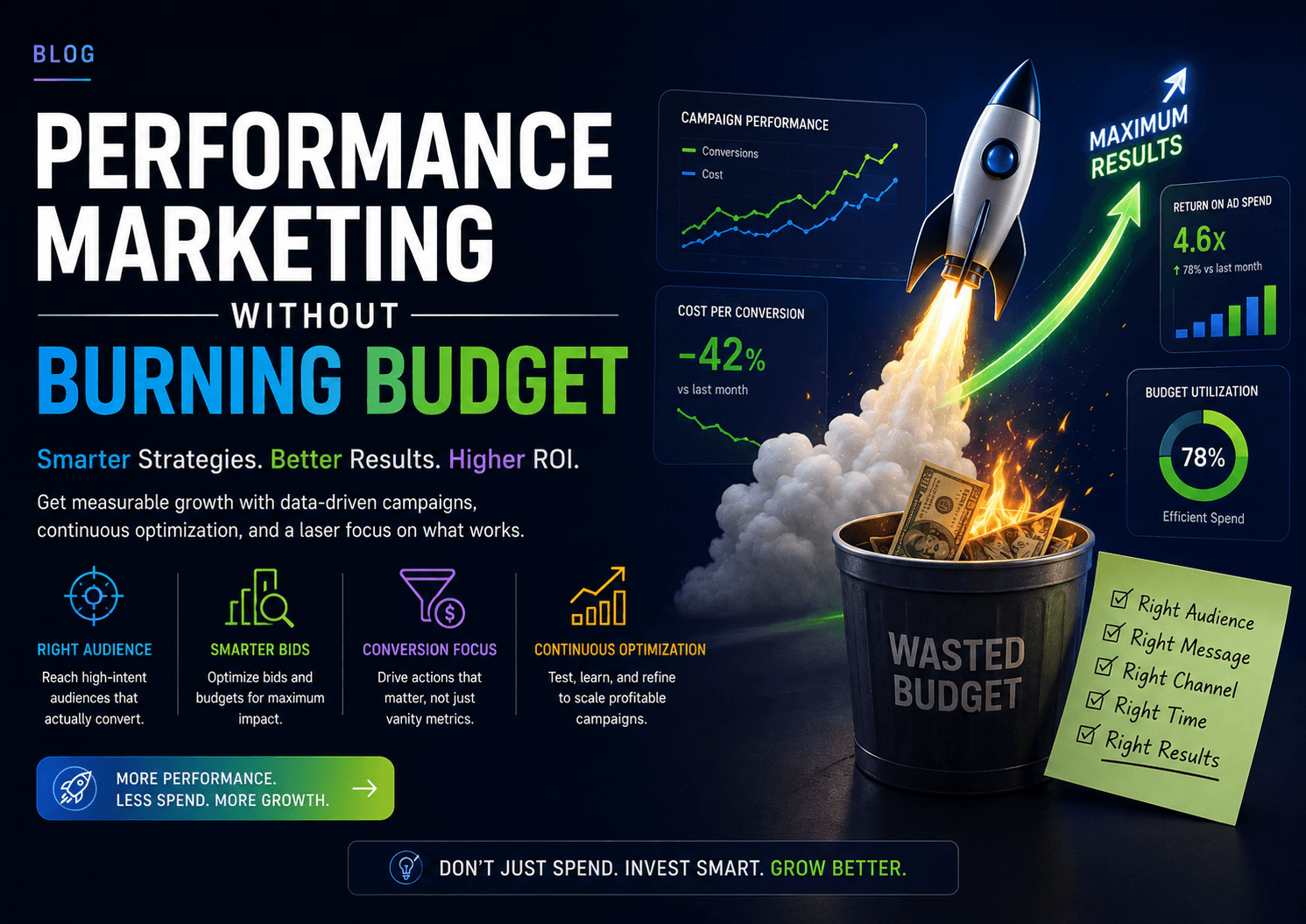
"Half the money I spend on advertising is wasted; the trouble is I don't know which half." - John Wanamaker, 1900
More than a century later, most marketing teams are still living this problem - except now the stakes are higher, the channels are noisier, and the average cost-per-click has never been more expensive. In 2026, the median CPM across major digital platforms is up 18% year-over-year, while the average conversion rate across industries sits at a modest 2.35%.
The math is unforgiving: pour money into a leaky system, and you don't just waste budget - you waste time, momentum, and the organizational trust that makes future investment possible.
This article is not about spending less. It is about spending smarter. It lays out the data, the diagnostic framework, and the specific tactics that separate performance marketing teams that compound their returns from those that perpetually reset to zero every quarter.
Part 1: The State of Performance Marketing in 2026 - What the Data Tells Us
Before diagnosing the problem, it helps to understand the environment every performance marketer is operating in right now.
Ad Costs Have Risen Faster Than Performance
Digital advertising costs have climbed steadily across every major platform. Google Search CPCs increased by an average of 19% in 2025. Meta's CPM rose 12% year-over-year in Q1 2026. Meanwhile, the global average landing page conversion rate has barely moved - it sits between 2% and 5% for most industries, with B2B SaaS averaging around 2.4% and e-commerce hovering near 1.8%.
The implication is significant: the same dollar buys fewer impressions, fewer clicks, and therefore fewer conversions than it did 24 months ago. Teams that haven't recalibrated their unit economics accordingly are running hotter than they realize.
Most Budgets Are Allocated to the Wrong Stage of the Funnel
Research from Nielsen and Forrester consistently shows that most paid media budgets are bottom-of-funnel heavy - bidding on purchase-intent keywords, retargeting warm audiences, pushing discount codes - while underinvesting in brand and mid-funnel demand generation.
The problem with this is structural. Bottom-of-funnel audiences are finite and shared with every competitor. When everyone bids on the same high-intent keywords, CPCs rise, and margins compress. The teams that win long-term are those that invest in creating demand, not just capturing it.
Attribution Is Broken, and Most Teams Know It
According to a 2025 State of Marketing Measurement report by Rockerbox, 72% of marketers describe their current attribution model as "somewhat inaccurate" or "very inaccurate." Last-click attribution - still the default in many platforms - over-credits search and direct, while systematically under-crediting brand, social, and upper-funnel touchpoints.
The practical consequence: teams using last-click attribution make systematically worse budget allocation decisions, cutting the channels that fill the top of the funnel because they don't appear to "close" the sale.
The Signal Loss Problem Has Compounded
Apple's App Tracking Transparency (ATT) rollout in 2021 was the first crack. The deprecation of third-party cookies, privacy regulation tightening across the EU, UK, and increasingly the US, and the fragmentation of identity graphs have all reduced the signal quality that algorithmic ad platforms rely on. As a result, automated bidding strategies - Smart Bidding on Google, Advantage+ on Meta - need more time and more conversion data to train effectively than they did three years ago. Underfed campaigns don't optimize; they guess.
Part 2: The Root Cause - Why Budgets Burn
Most budget waste in performance marketing can be traced to one of five structural failures. Understanding which failure pattern applies to your program is the essential first step.
Failure 1: Bidding for Conversion Without Enough Conversion Volume
Automated bidding systems require a minimum conversion signal to learn effectively. Google's official guidance recommends at least 30 conversions per month per campaign for Target CPA bidding; 50 is more reliable. Most small and mid-size accounts have conversion volumes well below this threshold, yet run automated bidding strategies anyway - resulting in erratic spend and inflated CPCs.
The fix: Either consolidate campaigns to concentrate conversion volume, or use a lower-funnel proxy conversion (micro-conversion) - such as a demo page visit or a lead form submission view - to give the algorithm more signal to work with before optimizing for the final conversion event.
Failure 2: Sending Paid Traffic to a Generic Page
The single most common performance marketing mistake is running highly targeted ads to a generic homepage or product page. Research by WordStream shows that the top 25% of landing pages convert at 5.31% or higher. The median is 2.35%. The gap between a well-built, message-matched landing page and a generic destination is often the difference between a $40 CPL and a $200 CPL - on identical ad spend.
The fix: Every distinct audience segment, value proposition, or offer should have a dedicated landing page with a single call-to-action, headline-to-ad message match, and no navigation links to distract the visitor.
Failure 3: Optimizing for Volume Instead of Quality
Optimizing for raw lead or conversion volume sounds rational - more leads should mean more revenue. In practice, it often means optimizing toward the path of least resistance: broad audiences, low-intent keywords, and weak offers that attract clicks but not buyers. The result is a bloated top of funnel that sales teams can't close, and a CAC that looks fine in the marketing dashboard but is catastrophic when accounting for close rates and LTV.
The fix: Integrate downstream data - CRM stage, MQL-to-SQL conversion rate, close rate by channel, average contract value by source - into campaign optimization. On Google, use value-based bidding with revenue-weighted conversion values. On Meta, upload CRM audiences of closed-won customers for lookalike modeling against people who actually buy, not just people who click.
Failure 4: Running Always-On Without a Testing Discipline
Many teams pour budget into campaigns that were "good enough" six months ago without systematically testing whether they still are. Creative fatigue is real: Facebook's own internal research suggests that creative performance begins degrading after approximately 3 to 7 days at scale for broad audiences. In high-spend accounts, the same ad shown to the same audience repeatedly produces diminishing returns that compound into significant waste.
The fix: Establish a standing creative testing cadence. At a minimum, introduce two to three new creative variants per month per active campaign. Structure tests with clean controls and statistically adequate sample sizes before declaring a winner.
Failure 5: Treating Performance Marketing as Isolated from the Rest of the Business
Performance marketing doesn't exist in a vacuum. It is sensitive to product quality (reflected in post-purchase churn), brand strength (reflected in direct type-in and branded search volume), landing page experience (reflected in Quality Score and conversion rate), offer competitiveness, and sales team close rates. Teams that optimize their paid media in isolation while ignoring these upstream and downstream factors are optimizing a small part of a broken system.
The fix: Build a cross-functional growth meeting - weekly or biweekly - that brings marketing, product, and sales together around shared metrics. The question is not "how did our ads perform?" but "how did the full acquisition-to-retention engine perform, and where is the biggest constraint?"
Part 3: The Budget-Efficiency Framework
High-performing performance marketing programs share a common structural logic regardless of channel mix or industry. Here is the framework that underlies the best ones.
Step 1: Establish the Unit Economics Floor
Before spending anything, define the maximum allowable CAC for the business. This is derived from lifetime value and target payback period.
The formula:
-
LTV = Average Revenue per Customer × Gross Margin × Average Customer Lifespan
-
Maximum CAC = LTV × Target Margin (typically LTV: CAC of 3:1 or better for SaaS; 2:1 for e-commerce with high repeat purchase)
If you don't know your LTV with reasonable confidence, segment it: LTV by acquisition channel, cohort month, and product tier will reveal dramatically different economics. Customers acquired through branded search typically have 40 to 60% higher LTV than those acquired through broad prospecting - a fact that should dramatically influence budget allocation but rarely does.
Step 2: Build a Conversion Architecture, Not Just a Campaign
A campaign is a tactic. A conversion architecture is a system. The difference: a system is designed end-to-end - from the audience targeting logic, through the creative and message, to the landing page, the thank-you sequence, the CRM handoff, and the downstream nurture. Every node is intentional and measured.
The four-layer conversion architecture:
Layer 1 - Audience precision: Who sees the ad? Are you targeting based on demonstrated intent (search behavior, site engagement, CRM data) or demographic proxies?
Layer 2 - Creative and message match: Does the ad speak to the specific problem this specific audience has? Does the creative change as the audience moves from awareness to consideration to purchase intent?
Layer 3 - Landing page and offer: Is the landing page built for a single conversion action? Is the offer differentiated from every competing ad the prospect has seen today?
Layer 4 - Post-conversion experience: What happens immediately after a conversion? The 24-hour window post-conversion is the highest-engagement period in any lead funnel. Most teams leave it completely unoptimized.
Step 3: Concentrate Before You Diversify
One of the most counterintuitive principles of budget efficiency: in the early stages of a program, concentration beats diversification. Running $10,000/month across five channels produces five underfunded experiments, none of which generate enough data to optimize. Running the same budget across two channels produces meaningful learning.
The principle: establish efficiency (a CAC below your maximum allowable threshold) in one channel before adding a second. Prove the unit economics work before scaling. Most teams do the opposite - they scale while still testing, then can't isolate what's working.
Step 4: Build a Budget Allocation Governance Cadence
Performance marketing budgets should not be static. They should be reallocated based on rolling performance data. The standard operating rhythm:
-
Weekly: Review conversion metrics, pacing, and anomalies. Make tactical adjustments (bids, creative swaps, negative keyword additions).
-
Monthly: Review channel-level CAC against target. Reallocate budget toward channels performing at or below CAC target; reduce or pause channels above threshold.
-
Quarterly: Review LTV cohort data by acquisition channel. Recalibrate the maximum allowable CAC based on actual downstream performance. Adjust the annual budget split accordingly.
Part 4: Channel-by-Channel Efficiency - Where the Data Points
Understanding the relative efficiency of each channel - not just top-line ROI, but CAC volatility, audience saturation dynamics, and diminishing returns curves - is essential to smart allocation.
Paid Search (Google, Microsoft)
Paid search is the most defensible channel because it captures existing demand rather than trying to create it. Users searching for your solution are already in-market; the cost is getting in front of them at the right moment with the right message.
The efficiency challenge: branded terms are the most efficient spend in almost every account, often converting 5 to 10 times better than non-branded terms at a fraction of the CPC. Many teams dramatically underbid their own brand terms while overspending on generic category keywords they can't win economically.
Efficiency action: Run a CAC analysis by keyword cluster - branded, competitor, generic category, and long-tail intent. In most accounts, the top 20% of keywords produce 80% of efficient conversions. The bottom 40% are waste. Kill them.
Data point: Companies that optimize their Google Ads structure for conversion value rather than volume see an average 23% reduction in cost-per-qualified-lead, according to WordStream's 2025 industry benchmarks.
Paid Social (Meta, LinkedIn, TikTok)
Paid social operates on a fundamentally different logic to search: you are interrupting someone who was not actively looking for you. The efficiency depends almost entirely on two factors - audience signal quality and creative quality.
Post-ATT, Meta's targeting has become less precise at the individual level but more powerful at the pattern level when seeded with high-quality first-party data. The teams generating the best Meta efficiency in 2026 are those with large, well-maintained CRM databases that they use to build value-based lookalikes, and those with strong creative testing operations that refresh assets frequently.
LinkedIn delivers the highest quality B2B leads in paid social,l but at CPCs that routinely run 5 to 10 times higher than Meta. It is appropriate for enterprise deals where the LTV justifies it; almost always inefficient for SMB acquisition.
Efficiency action: On Meta, shift your primary conversion signal away from "leads" or "purchases" toward revenue-weighted custom conversions that reflect actual deal value. This trains the algorithm to find customers, not just converters.
Data point: Advertisers using value-based lookalike audiences seeded from CRM data report 37% lower CPAs than those using interest and demographic targeting alone.
Email and Lifecycle Marketing
No channel in the performance marketing stack delivers ROI per dollar anywhere close to email. The Litmus 2025 State of Email report puts average email ROI at $36 for every $1 spent - 4,200% return. Even with modest list sizes, a well-segmented behavioral email program can generate a pipeline that would require 10 to 20 times the investment to replicate through paid channels.
The efficiency failure mode in email is treating it as a broadcast. Sending the same message to every subscriber produces industry-average open rates of 21.3%. Behavioral segmentation - different sequences for different actions the user has taken in your product or on your site - consistently produces open rates of 45 to 60% because the message is contextually relevant.
Efficiency action: Map your email program against the user action that triggered it. Every message should be sent because the recipient did something specific, not because the calendar says it's Tuesday.
Retargeting
Retargeting is the highest-intent audience you can access in paid media - people who have already visited your site, engaged with your content, or started a purchase flow. Done well, it is exceptionally efficient. Done poorly, it is the fastest way to annoy warm prospects into never buying from you.
The most common retargeting failure: no frequency cap, no segment exclusion, no end date. A prospect who visited your pricing page and bounced does not need to see your ad 40 times over the next two weeks. They need to see it 4 to 6 times with a clear, differentiated message - then be excluded from retargeting and moved into a CRM nurture sequence instead.
Efficiency action: Build retargeting audiences by intent tier: high intent (pricing/demo page visitors), mid intent (blog/feature page visitors), and low intent (homepage bouncers). Apply different creative, different offers, and different frequency caps to each. Exclude converters immediately.
Part 5: The Measurement Architecture That Actually Works
You cannot improve what you measure inaccurately. The attribution problem is real, and the solution is not to find the "perfect" attribution model - it doesn't exist. The solution is to use multiple measurement approaches in combination and triangulate toward the truth.
The Three-Layer Measurement Stack
Layer 1 - Platform-native attribution (for tactical optimization). Use this for within-platform bid optimization only. Google's last-click, Meta's 7-day click attribution - these are useful for teaching the algorithm, not for making budget allocation decisions.
Layer 2 - Multi-touch attribution (for budget allocation). Tools like Northbeam, Triple Whale, or Rockerbox provide a more complete picture of how channels work together. They reveal, for instance, that paid social rarely closes sales but frequently initiates consideration - a finding that should influence how you evaluate Meta's "efficiency" against a last-click lens.
Layer 3 - Incrementality testing (for truth) The most accurate measurement methodology available: geo-based holdout tests, conversion lift studies, and media mix modeling. These tell you not what channel was present in the conversion path, but what would have happened without it. This is the layer most teams skip because it is harder to set up - and the reason most teams make systematically poor budget decisions.
Data point: Companies that implement incrementality testing reallocate an average of 28% of their budget after seeing the results, according to Meta's 2025 Measurement Playbook. The most common finding: branded search was taking credit for conversions that would have happened anyway; social and display were driving more incremental lift than last-click suggested.
The North Star Metric Problem
Many performance marketing teams optimize toward a metric that is easy to measure but not actually tied to business outcomes. "Leads" is the classic example. A lead is a data point, not revenue. The teams with the most disciplined budget management optimize toward metrics that connect directly to revenue: pipeline value, MQL-to-close rate, cost-per-qualified-pipeline-dollar, or revenue generated per marketing dollar spent.
This requires CRM integration with your marketing stack - not optional, foundational.
Part 6: The AI Efficiency Layer
Artificial intelligence has introduced a new efficiency lever at every stage of the performance marketing stack. The teams winning in 2026 are not those spending more - they are those who have integrated AI into their operations in ways that compound the value of every dollar spent.
Predictive Audience Modeling
Rather than targeting demographic proxies or interest categories, AI-powered tools can now predict which users are most likely to convert - and at what value - based on behavioral patterns that no human analyst could identify at scale. Platforms like Mutiny, 6sense, and Clearbit Reveal use firmographic and behavioral data to identify high-propensity accounts before they engage, enabling proactive outreach and hyper-personalized landing experiences.
Creative Generation and Testing at Scale
Creative refresh is the most labor-intensive aspect of paid social management. AI-powered creative platforms - including Pencil, Smartly, and Canva's AI generation layer - can now produce dozens of creative variants from a single brief in hours rather than days. This collapses the time-to-test cycle and enables genuine creative diversity rather than running the same four ads until frequency destroys performance.
Data point: Companies using AI-assisted creative generation increase their creative testing velocity by an average of 3.8x, which correlates with a 24% improvement in ROAS over 90 days, according to Smartly's 2025 performance benchmark.
Automated Budget Pacing and Reallocation
Manual budget management across multiple channels and campaigns is one of the most time-consuming and error-prone aspects of performance marketing. AI budget management tools - including tools built into Google's Performance Max, as well as third-party platforms like Skai, Marin, and Adspert - now enable rule-based and model-driven reallocation in real time, shifting spend toward the best-performing combinations without waiting for a weekly review.
Part 7: The Efficiency Audit - Where to Start This Quarter
The fastest path to better performance marketing efficiency is not launching a new channel. It is auditing what you already have. Here is a structured audit sequence that takes roughly five business days:
Day 1 - Unit economics audit: Calculate your actual CAC by channel, not blended. Compare to your LTV-derived maximum allowable CAC. Identify any channels currently operating above the threshold.
Day 2 - Conversion architecture audit: Walk through your top three campaigns end-to-end, from the ad to the post-conversion email. Score each node: audience precision, message match, landing page CRO, and post-conversion sequence.
Day 3 - Attribution audit: Run a last-touch CAC analysis side-by-side with a multi-touch model if available. Identify the largest discrepancies. Flag the channels that are likely under-credited.
Day 4 - Keyword and audience efficiency audit: Pull a keyword-level CAC report in Google. Identify the top 20% performing and the bottom 20% performing. Estimate the budget reallocation impact of pausing the bottom tier.
Day 5 - Creative performance audit: Analyze creative fatigue indicators - frequency, CTR decay curve over time, conversion rate by creative age. Identify ads that have been running beyond their effective lifespan.
By the end of day five, most teams identify between 20% and 35% of the current budget that could be reallocated to higher-performing uses without any incremental investment.
What Doesn't Work Anymore
Just as important as knowing what to do is knowing what to stop.
Broad match everything with maximized conversions, no guardrails. Google's automated systems are powerful, but unconstrained; they will find the cheapest path to your conversion event - which is often not the highest-value path. Smart Bidding needs constraints: target CPA floors, portfolio bid strategies with clear caps, and value rules that reflect downstream revenue.
Vanity metric dashboards. Impression share, reach, engagement rate - these are not performance metrics. They are proxies. Build your reporting dashboard around metrics that connect directly to revenue: CPL, CAC, pipeline value created, and CAC:L TV ratio.
Running the same creative for more than 30 days at a meaningful scale. Creative fatigue is not a theory; it is measurable. CTR decay and frequency-adjusted conversion rates tell you exactly when an asset stops earning its place. Replace it before performance forces your hand.
Treating performance marketing as separate from product and brand. The teams with the lowest CAC in every category are those with strong organic demand - driven by brand equity, word-of-mouth, and product-led distribution. Performance marketing amplifies an existing signal; it cannot manufacture one that doesn't exist.
Conclusion: Engineer the System, Not the Campaign
The performance marketers who consistently generate efficient returns in 2026 share one defining characteristic: they think in systems, not campaigns. They understand their unit economics precisely. They build measurement architecture that tells them the truth. They concentrate the budget before diversifying. They test creative relentlessly. They close the loop between paid media and what actually closes downstream.
Budget waste is not a media buying problem. It is a systems problem - and systems can be fixed.
The framework is straightforward even when the execution is not: define your economics, build your conversion architecture, measure accurately, optimize ruthlessly, and let the data - not instinct, not convention, not platform defaults - drive every dollar of allocation.
That is how ad spend becomes pipeline. And the pipeline becomes growth.
Key Takeaways
- The median digital advertising CPM is up 18% year-over-year, while average conversion rates remain flat - making budget efficiency a structural business issue, not just a tactical one.
- Most budget waste traces to five root causes: underfed automated bidding, generic landing pages, volume-over-quality optimization, absent creative testing cadence, and siloed marketing operations.
- The unit economics floor (maximum allowable CAC derived from LTV and payback period) should govern every budget decision - not historical spend levels or competitor benchmarks.
- Last-click attribution is the most common source of bad budget allocation decisions. Multi-touch and incrementality testing reveal a meaningfully different reality.
- Email delivers up to 4,200% ROI - the highest return per dollar of any channel in the stack - yet most programs remain severely underoptimized through broadcast-style deployment.
- AI-powered creative generation increases testing velocity by an average of 3.8x, directly improving ROAS without increasing spend.
- The most effective performance marketers run a quarterly efficiency audit that typically identifies 20 to 35% of budget available for reallocation - with zero increase in total investment.
Ready to build a performance marketing system that compounds rather than leaks? Talk to the Kariux team about how we help ambitious businesses turn ad spend into a predictable pipeline.