

Administrator
Author · Jun 08, 2026
"If you're not embarrassed by the first version of your product, you've launched too late." Reid Hoffman, co-founder of LinkedIn
Reid Hoffman's quote is probably the most quoted thing in startup land. It's also the most misunderstood.
Founders hear "embarrassing is fine" and interpret it as a license to ship a broken, confusing, half-baked mess. Then they wonder why nobody comes back. The distinction Hoffman was actually making is about incompleteness, not embarrassment-as-strategy. Ship narrow. Ship fast. Don't ship broken.
There's a graveyard of MVPs that got this wrong. Products with five features that should have had one. Onboarding flows that confused the people who were actively trying to use them. Landing pages that didn't explain what the product did. And founders who blamed "the market" for a problem that was the product.
This article is a practical guide to building an MVP that validates your idea without torching your reputation in the process. No theory. No buzzwords. Just what actually works and what doesn't.
First, the Numbers That Should Scare You
Before getting tactical, let's acknowledge the terrain.
According to CB Insights, "no market need" accounts for approximately 42% of startup failures. Not bad timing. Not bad execution. People simply didn't want what was built. This is the problem an MVP is designed to solve, and yet it routinely isn't, because the MVP is built before anyone really understands the problem.
Premature scaling, building, and hiring ahead of validated demand is responsible for the failure of over 70% of startups. Nearly 50% of new ideas fail because they were never properly validated in the early stages. And the companies that rush into development without a structured approach waste an average of 6-9 months and $50,000-$150,000 building features users don't want.
Now the good news: startups that use an MVP approach have a 60% higher success rate than those that launch with fully-featured products. MVPs can lower development costs by up to 60% compared to traditional product development. And companies that iterate based on user feedback within 30 days of launch are 3x more likely to achieve product-market fit.
The tool works. The problem is almost always the execution.
The Single Most Common MVP Mistake
Ask any product consultant what kills MVPs, and they'll give you the same answer: too many features.
Seventy percent of MVP failures stem from building too many features. Not too few too many. The founding team falls in love with their vision, loses sight of what they're actually trying to learn, and ships something that tries to do everything while being unusable for anything.
The antidote is deceptively simple: identify the one hypothesis your MVP needs to validate, then build only what's required to test that hypothesis.
Not five hypotheses. One.
When Dropbox founder Drew Houston had the idea for cloud file-syncing, his core hypothesis was: "People want this badly enough to sign up for it." That's all he needed to test. He didn't build the product. He made a three-minute explainer video showing how the product would work. Overnight, beta signups exploded from 5,000 to 75,000+. The hypothesis was validated. Now he could justify building the real thing.
When Brian Chesky and Joe Gebbia had the idea for what would become Airbnb, their hypothesis was: "Strangers will pay to stay in other people's homes." Their MVP was a basic webpage with a few photos of their San Francisco apartment, a signup form, and some contact information. They handled bookings manually and had three paying guests almost immediately. Hypothesis validated.
Neither of these is impressive as a product. Both of them are brilliant as experiments.
The question every founder should be asking before writing a single line of code: What is the one thing I need to prove to myself and investors before building further?
What an MVP Actually Is (and Isn't)
The confusion runs deep enough that it's worth being explicit.
An MVP is not a prototype. A prototype tests whether users can navigate the design. An MVP tests whether users want the thing badly enough to pay for it, use it, or meaningfully engage with it.
An MVP is not a beta. A beta is a nearly-complete product released for stability testing. An MVP is a stripped-down product released for learning.
An MVP is not "the full product, but rushed." This is where most teams go wrong. They treat the MVP as a deadline for shipping a feature set, rather than a framework for running an experiment.
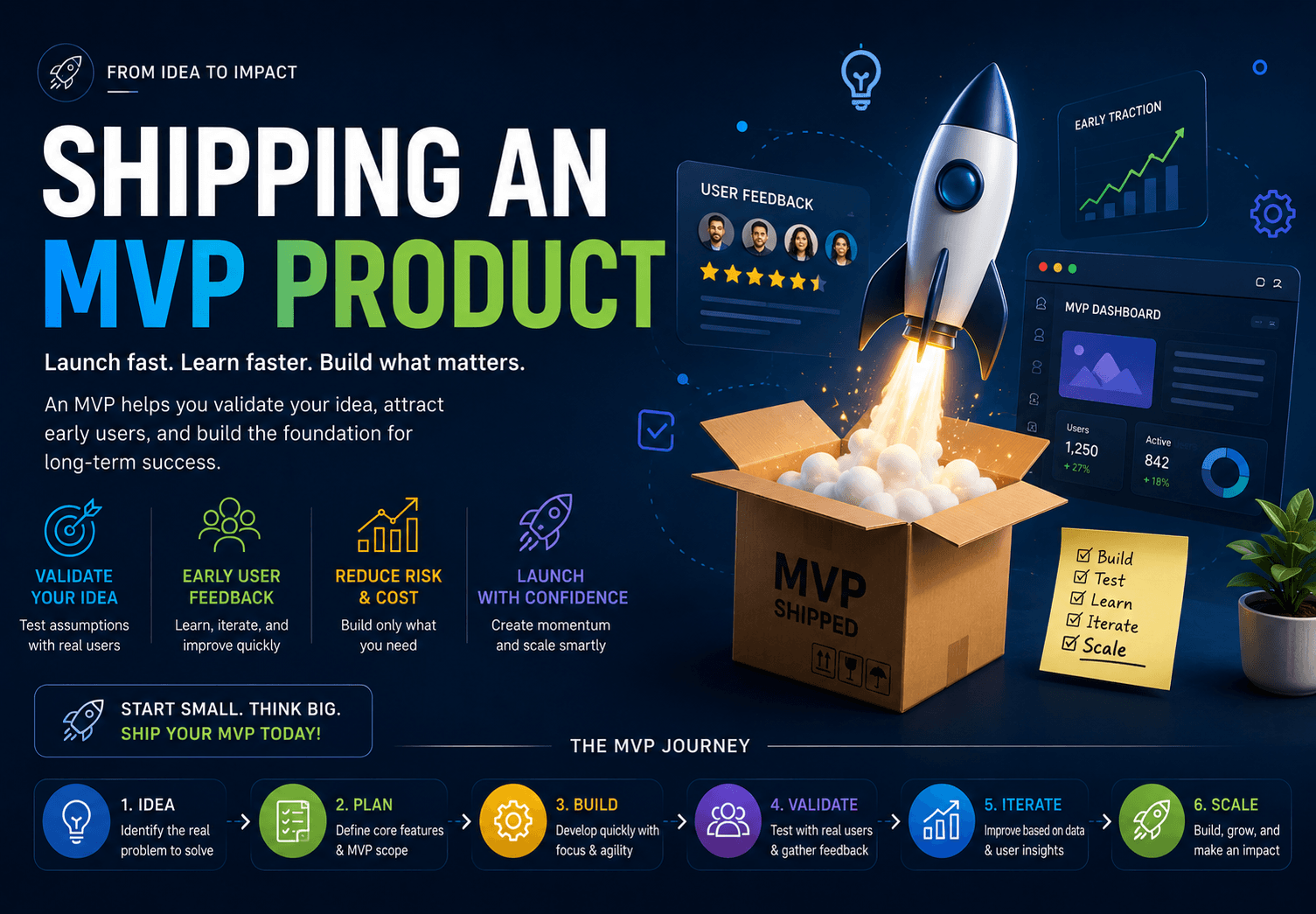
A useful definition: An MVP is the smallest version of your product that lets you test your core assumption with real users, with real stakes.
"Real stakes" is the key phrase. If users don't have to commit any money, time, or data, you're not learning whether the product works. You're learning whether people are willing to click around something free.
The Four MVP Types Worth Knowing
Not all MVPs look the same. The right type depends on what you're trying to validate.
1. The Explainer Video MVP
Best for: Validating whether demand exists before building anything.
Dropbox's approach. Create a clear, honest demonstration of what your product will do. Measure signups, waitlist conversions, and inbound messages. If nobody reacts, the core idea may not have the demand you assumed.
Warning: This validates stated interest, not actual behavior. People saying "I'd use this" and people using something are different data points.
2. The Concierge MVP
Best for: Validating whether your solution works, before you've automated it.
You manually deliver the outcome that the product will eventually automate. The user experience looks like a product; the backend is humans doing the work. Airbnb's founders serving as hosts and manually handling bookings is the classic example. Zappos founder Nick Swinmurn photographed shoes from local stores and listed them online. When someone ordered, he'd buy the shoes and ship them himself. He was testing whether people would buy shoes online without trying them on. They would.
The concierge MVP lets you learn deeply about the customer's experience, discover edge cases you wouldn't have anticipated in a design doc, and validate the unit economics before writing the automation.
3. The Landing Page MVP
Best for: Validating whether a specific audience segment converts on a specific value proposition.
Buffer, the social media scheduling tool, launched with a two-page website: one page explaining what Buffer would do, one page with pricing tiers. No product yet. Joel Gascoigne, the founder, wanted to know if people would pay before he built anything. People clicked "sign up," reached a "we're not ready yet" message, and left their email. Conversion rate data and email volume answered the question.
4. The Single-Feature MVP
Best for: When you need a real, working product to test the core behavior.
Sometimes you need users to actually do the thing your product enables because the learning only comes from watching them try. In this case, build one feature, and only one. Not the feature that's most impressive. The feature that is most central to the value proposition.
Instagram launched as Burbn, a check-in app with too many features and mediocre traction. The founders noticed that of all the things the app could do, users overwhelmingly just posted photos. They stripped everything else out, rebuilt around photo-sharing, and launched Instagram. The rest is a $1 billion acquisition story.
The Six-Question Framework Before You Build
Before committing to any development, force yourself to answer these six questions clearly. If you can't answer them, you're not ready to build.
1. What specific problem are you solving, and for whom exactly?
Not "people who want to save time." Not "small businesses." The more specific the better: "Freelance copywriters who lose 3+ hours per week chasing unpaid invoices." Vague problems produce vague products.
2. What's the one thing users must be able to do in your MVP?
One thing. If your answer involves the word "and," you have more than one thing. Cut until you don't.
3. What user behavior proves your hypothesis is correct?
Not a sentiment metric. Not a pageview. Define the behavior that would tell you the product is working: "User completes their first invoice, and it gets paid within 7 days."
4. How will you get your first 10 users?
Not your first 1,000. Your first 10. If you can't name where they'll come from and how you'll reach them, the MVP has no test subjects. This step has killed more MVPs than bad code ever has.
5. What does "this isn't working" look like?
Define failure criteria before you launch, not after. Humans are extraordinarily good at rationalizing post-hoc. Pre-commit to the signal that tells you the hypothesis is wrong, so that when you see it, you act rather than rationalize.
6. What will you build next if it works?
If you haven't thought past the MVP, you're building a project, not a company. Having a rough sense of what validated success enables you to build next keeps your MVP aligned with a larger product direction.
What Actually Belongs in Your MVP
A reliable filter: every proposed feature must pass the "does this help validate the core hypothesis?" test. If yes, it might belong. If no, it doesn't belong in the MVP full stop.
Here's a shortcut framework used by high-performing product teams: Three columns.
-
Must Have: Without this, the core hypothesis cannot be tested at all
-
Nice to Have: This would make the experience better, but it isn't required to learn
-
Someday: Ideas for later; cut from all MVP conversations
Most teams put too many things in the first column because they're afraid of shipping something minimal. Push back hard. The Must Have column should make you slightly uncomfortable with how small it is.
Some practical guidance on what almost never belongs in an MVP:
-
Advanced analytics dashboards (you'll have five users; you don't need Mixpanel integrations)
-
Multiple user roles and permission systems (built for one user type first)
-
Mobile app and web app simultaneously (pick one)
-
Integrations with "nice to have" third-party tools
-
Dark mode
-
Notification preferences
-
Settings pages beyond the absolute minimum
The things that almost always do belong: a clean onboarding path, a clear explanation of what the product does on the first screen, and one core workflow that works flawlessly from end to end.
The "One Core Workflow" Rule
This is the principle that separates MVPs that test something from MVPs that confuse everyone.
Identify the single most important journey a user should complete in your product. From the moment they sign up to the moment they get the value you promised. Then make that journey work perfectly. Every bug in that workflow should be fixed before you add anything new. Every friction point should be removed. Every confusing label should be rewritten.
Everything outside that workflow can be rough. The edges can be ugly. But the core path? It has to work.
Teams that violate "one core workflow" ship products where users get lost, drop off at step two of three, and never reach the value moment that justifies the product's existence. Then the analytics show "low engagement", and the team adds more features to solve an engagement problem that is actually a clarity problem.
When to Use AI Tools to Build Faster
In 2026, a solo founder with a $10,000 budget can build what previously required a venture-backed engineering team. AI-assisted development tools (Lovable, Bolt, v0, Replit Agent) have compressed time-to-prototype dramatically.
The pattern that's working for technical and non-technical founders alike:
-
Days 1-7: Describe the problem to an AI builder, ship a working prototype to a small private group
-
Weeks 2-4: Usage signals reveal which parts of the product matter; the rest gets cut
-
Month 2+: If the hypothesis holds, either rebuild the validated parts on a production-grade stack or bring in engineering talent now that the bets are confirmed
Across global startup ecosystems, AI has helped teams ship MVPs 30-50% faster than in pre-AI years. Businesses using low-code and no-code platforms deliver MVPs 50-70% faster with cost reductions of 50-65% compared to traditional development.
The important caveat: AI-generated MVPs are expensive to refactor after launch, once real data pipelines, feedback loops, and business workflows depend on them. Architectural shortcuts made at speed become technical debt at scale. Use AI tools to validate the hypothesis, then build the real architecture when the hypothesis is confirmed.
As one product leader put it: "The bottleneck isn't engineering talent anymore, it's people who understand customer problems deeply enough to know what to build."
The First Two Weeks After Launch
Most MVP founders do the same thing wrong after launch: they wait for analytics to tell them something.
Don't wait. Call your users.
The first 10-20 users of any product are the most valuable data source you will ever have access to. They signed up, which means they believed in the problem enough to try the solution. They have opinions. They noticed things you didn't. They have questions you didn't anticipate.
Talk to them within 48 hours of them signing up. Not a survey. An actual conversation. Ask:
-
What made you decide to try this?
-
Walk me through what you did when you first logged in
-
What was confusing?
-
What would you need to see to keep using this?
-
Would you pay for this? What's the most you'd pay?
The answers to these questions will tell you more than a month of behavioral analytics. They'll surface the language users actually use to describe their problem (invaluable for your copy), the friction points you didn't know existed, and whether the people who signed up are actually your target customer.
Companies that iterate based on user feedback within 30 days of launch are 3x more likely to achieve product-market fit. The iteration only happens if you know what to iterate on. That comes from conversations, not dashboards.
How to Know When the MVP Has Done Its Job
An MVP is not a destination. It's a phase. Knowing when to graduate out of it matters as much as knowing how to build it.
You've learned what you needed to learn from the MVP when:
Retention is "good enough" for your category. You're seeing users return and repeat the core action without being prompted. You're not looking for perfection, you're looking for evidence of genuine need.
Someone is paying. Even one dollar from one customer who isn't your friend or family member changes the nature of what you're building. It validates willingness to pay, which is the single most important signal an MVP can produce.
You know what to build next. The MVP has surfaced enough signals that you can articulate with confidence: "We know who this is for, what problem it solves, why they come back, and what we need to build next to grow adoption."
The core workflow is breaking under load. If usage is growing and the infrastructure is straining, that's a strong sign. Problems of success are different problems.
At that point, the MVP's job is done. The focus shifts from validation to execution, UX polish, security, analytics, proper architecture, customer success, and a roadmap driven by real usage data rather than founder hypotheses.
The Part Everyone Skips: The "Embarrassing" That Actually Matters
Let's return to Reid Hoffman's quote, because the second half of it is what most people miss.
There are two kinds of MVP embarrassment. There's the embarrassment of incompleteness: you only built one feature, the design is rough, and the onboarding is manual. That embarrassment is fine. That's what Hoffman was talking about. Ship it anyway.
Then there's the embarrassment of broken core workflow crashes, the copy is so unclear that users can't figure out what to do, and the product makes promises it doesn't keep. That embarrassment is not fine. It's not a sign of lean thinking; it's a sign of insufficient respect for your users' time.
The distinction matters because the "embarrassment is fine" culture has been used as cover for an awful lot of bad product thinking. Users who have a poor first experience with your MVP don't become enthusiastic early adopters who give you generous feedback. They leave and don't come back, and they might tell people about it.
The bar is not "impressive." The bar is "clearly useful for the one thing it does."
Hit that bar, and the incompleteness doesn't matter. Miss it, and the feature list doesn't matter.
The Checklist Before You Ship
Run through this before you launch to any real users:
-
Can a first-time user understand what this product does in under 10 seconds on the landing page?
-
Can they complete the core workflow without asking you for help?
-
Does the core workflow work without errors every time?
-
Have you watched at least 5 people try to use it without coaching them?
-
Do you have a direct way to collect feedback (email, in-app chat, feedback form)?
-
Have you defined what "success" looks like in the first 30 days, in measurable terms?
-
Do you know how you'll reach your first 10 users?
-
Have you cut every feature that isn't required to test the core hypothesis?
If you can check every box, ship it. If you can't figure out why, resist the temptation to add more features as the answer.
Conclusion: Minimum Viable, Maximum Intentional
The "minimum" in MVP is about scope. The "viable" is about quality. Both halves matter equally, and neither is optional.
Ship narrow. Ship fast. But make the thing you ship work, be clear, and deliver on its promise for the single problem it's trying to solve.
The graveyard of failed MVPs is not full of products that shipped too small. It's full of products that tried to do too much, confused their first users, never got real feedback, and scaled before they found product-market fit.
Your MVP is not your product. It's your first conversation with the market. Make it coherent, make it honest, and above all, make it fast.
Quick Reference: MVP by the Numbers
|
Metric |
Data Point |
|
Startup failure due to "no market need" |
42% (CB Insights) |
|
MVP failures caused by too many features |
70% |
|
Success rate improvement with the MVP approach |
+60% (Startup Genome) |
|
Development cost reduction via MVP |
Up to 60% |
|
Faster time-to-market with MVP |
~35% |
|
Startups using the MVP approach |
72% |
|
3x more likely to reach PMF if iterating within 30 days |
Yes |
|
Cost to build a typical SaaS MVP in 2026 |
$30K-$140K |
|
Time to build a typical SaaS MVP in 2026 |
8-14 weeks |
|
AI-assisted MVP speed improvement |
30-50% faster |
If this article helped you think through your MVP, share it with your co-founder. And if you're about to start building, stop. Answer the six questions first.